YouTube growth, without the noise.
Tactics, channel deep-dives, and creator playbooks from the team behind YTGrowth. Written by humans, tested on real channels.
 Growth
YouTube Channel Plateaued After 1,000 Subscribers?
The same 50 subscribers a month is 50% growth at 100 subscribers and 5% at 1,000. Nothing has to break for that number to fall, and YouTube's published recommendation signals contain no subscriber-count threshold at all. Here's how to tell arithmetic apart from a real stall.
More from the blog
 Analytics
How Many Views Should You Get Per Subscriber on YouTube? Measured Across 1,152 Channels
Measured across 1,152 tracked channels and 55,964 videos: median views per upload at 10K, 100K, and 1M subscribers, plus the real finding behind the view count that looks low next to your subscriber total. The share of subscribers who watch a new upload falls from 10.58% to 2.93% as a channel grows.
 Growth
Is My YouTube Channel Shadowbanned?
YouTube has never used the word "shadowban." It does officially describe a real mechanism: reduced recommendation of borderline content to non-subscribers only, with real numbers attached. Here's how to tell that apart from the far more common causes of a reach drop.
 Strategy
Why YouTube Is Showing Your Video to the Wrong Audience
Click-through rate holding steady while views fall is the real tell: YouTube tested the video with the wrong audience pool, not a packaging failure. Seven real causes, how to tell which one is yours from your own Studio data, and why clever titles alone rarely fix it.
 YouTube Subscribers
Why Your YouTube Subscriber Count Keeps Dropping
Most subscriber loss isn't a content problem. YouTube runs its public count, search results, and Studio Analytics on different update schedules, up to 48 hours apart, so a drop that looks tied to your newest video is often two numbers from two different systems. The real causes, and how to tell which one is yours.
 Monetization
Why Your YouTube Watch Hours Are Dropping
Falling below 4,000 watch hours does not cost an already-monetized channel its monetization, confirmed directly against YouTube's own help page. Two separate problems get confused under this one question: a channel still climbing toward 4,000, and one already past it. Different causes, different fixes.
 Monetization
Why YouTube Views Drop Right After Monetization
A channel usually gets accepted into the Partner Program right after its strongest video ever, then every normal upload after that looks like a collapse against that inflated baseline. Three causes are pure timing coincidence. One, an auto-inserted mid-roll ad, is the real exception, and it's checkable in Studio.
 Analytics
What Counts as Viral on YouTube, Measured Across 54,880 Videos
Every guide gives a flat number: 1M, 5M, 10K. None of them measure it. We checked 54,880 videos across 1,040 channels against each channel's own median, and half of all videos don't even beat that. The real thresholds, by subscriber tier, format, and niche.
 Growth
YouTube Stopped Recommending My Videos: The Real Reasons
Most advice on this still explains the algorithm the way it worked in 2023. Session contribution is now the leading signal for Suggested placement, and Shorts recommendation has been fully separate from long-form since late 2025, two current facts that change what's worth checking first.
 Growth
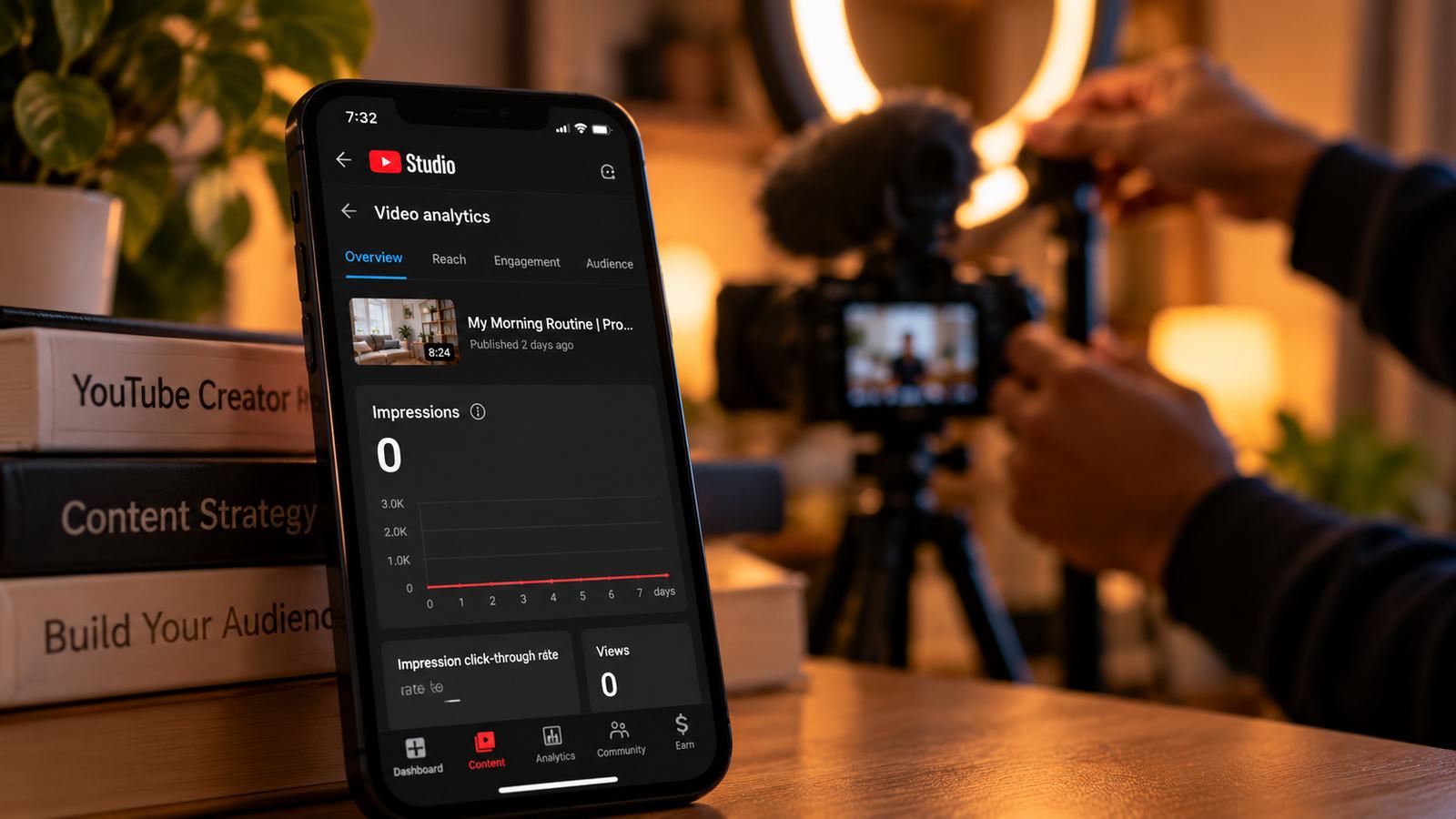
Why Did My YouTube Impressions Drop?
Impressions are the one number YouTube controls before a viewer ever sees your video. A sudden drop means the algorithm changed its mind about showing you to people, and that decision traces to one of four specific triggers, not a mystery penalty.
 Growth
Why Did My YouTube Views Drop Suddenly?
A sudden view drop isn't one problem. It's one of three: something on your channel changed, your old baseline was never real to begin with, or YouTube's own counting shifted under you. Each needs a completely different fix, and most guides only cover the first.
 Analytics
How to Get More Impressions on YouTube (and Why Yours Might Be Stuck)
Most guides define impressions and stop at generic CTR advice. "Low impressions" is several different problems: good CTR and retention with impressions still capped, impressions that suddenly stop, or a channel that never had them. Here's what YouTube counts as an impression, and which real pattern matches yours.
 Analytics
How to See YouTube Analytics for Other Channels (What's Public vs. Private)
You cannot see another channel's real analytics, no tool can show you their CTR, retention, or revenue. What you can see is specific public data: subscriber count, total views, video count, and upload dates. Here's the honest boundary, and how to check it in seconds.