Impressions are the one YouTube number that happens entirely without you. You don't post an impression, the algorithm decides to show your thumbnail, and a sudden drop means it changed that decision. Four things cause that change: a restriction on the video, one bad upload dragging down the whole channel, a new video still being tested, or your niche's audience moving elsewhere.
Only the first two are things you did. The last two are the algorithm reacting to something outside your control, and treating them as a packaging problem wastes the fix on the wrong lever.
Start With the One Cause That Leaves a Trace
A strike, copyright claim, or restriction notice in Studio's Content tab is the only cause on this list that shows up as a visible flag. Everything else has to be inferred from a pattern in your numbers, so ruling this one in or out first saves time chasing a theory when the answer was sitting in Studio the whole time.
If a video is demonetized or age-restricted, its impressions can fall sharply without the rest of the channel being touched at all. A channel-wide drop with no individual video flagged points at the next cause instead.
Worth a quick check before moving on: YouTube does occasionally post about platform-wide issues on its official status and creator channels. A drop that hit every creator in your niche at the same time, not just your channel, is the one scenario where the cause genuinely sits outside anything in this article.
One Bad Upload Can Cost the Whole Channel
YouTube doesn't evaluate videos in isolation, it reads your last few uploads as a pattern. A recent video with CTR or retention well below your normal range teaches the algorithm your channel's quality just dropped, and it pulls back distribution on everything, not just the weak video.
Pro Tip: pull up your last 5 uploads' CTR and average view duration side by side in Studio. One outlier in the middle of an otherwise normal run is the signature of this cause specifically, not a channel-wide decline.
This is also why fixing the thumbnail on an older, already-published video rarely restores impressions on newer ones. The algorithm is reacting to the pattern, not any single piece of metadata.
A Brand-New Video Hasn't Been Tested Yet
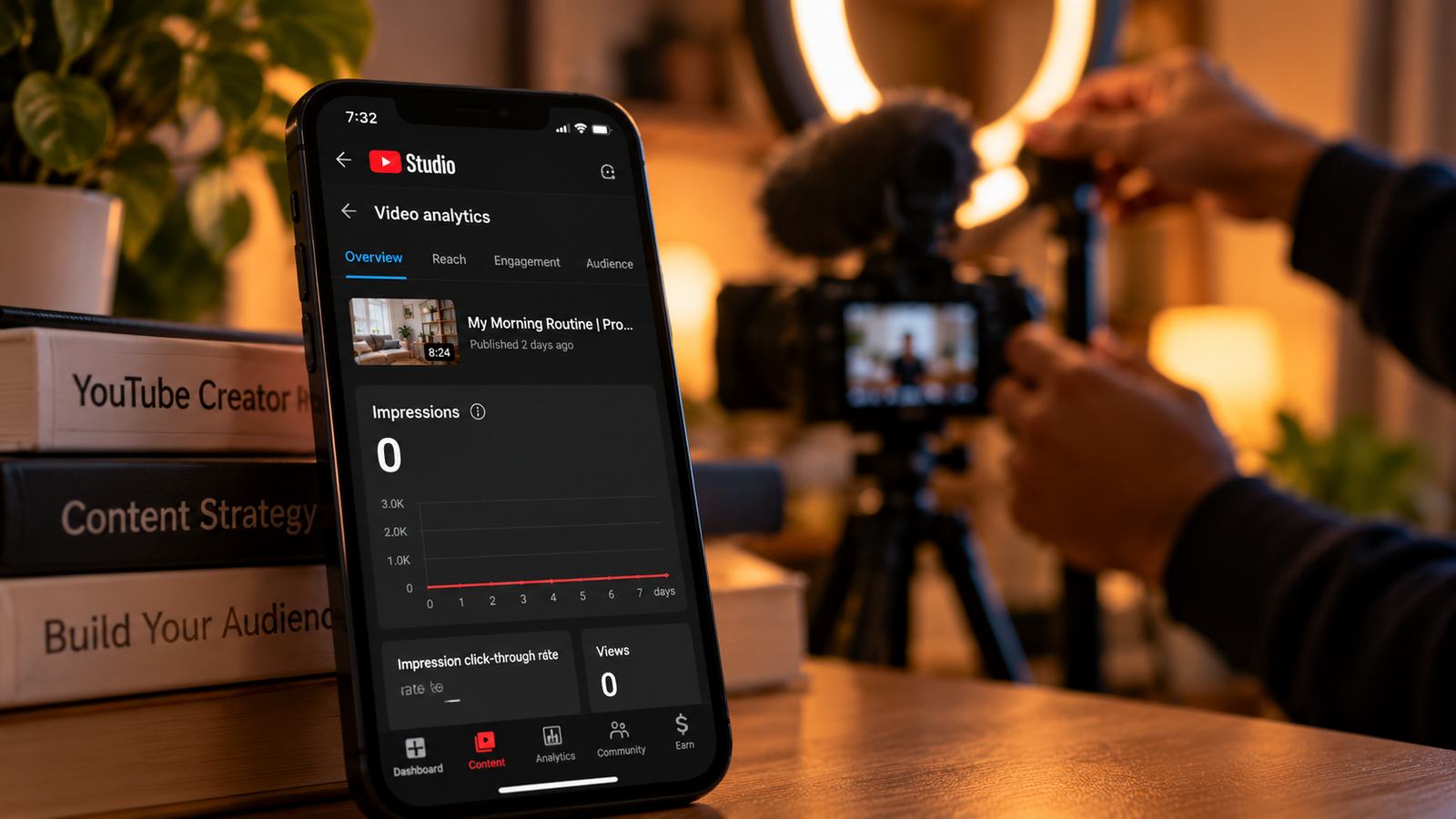
Every upload goes through a short window where YouTube shows it to a small sample audience before deciding how far to push it. A video sitting at zero impressions a few hours after publishing is usually still inside that window, not rejected. Studio typically starts populating data within a few hours, not instantly.
If a video still shows zero impressions after 24 hours, that's no longer the testing window, that's a processing or restriction issue worth checking Studio's Content tab for directly.
The Algorithm Didn't Change, Your Audience Did
More creators publishing in your niche, or your existing audience's interests shifting to a different topic, can pull impressions down with nothing wrong in your own videos. This shows up specifically in Home and Suggested, the surfaces most sensitive to shifting interest, while Search impressions tend to hold steadier since they're tied to query relevance rather than audience mood.
A narrower version of this is saturation, not a shift. If a topic has a genuinely small audience and your channel has already reached most of the people who want it, impressions on new videos covering that same topic settle lower, not because interest moved elsewhere but because there's less room left to find new viewers for it.
A quiet stretch between uploads compounds this. Distribution trust rebuilds with consistent uploads over weeks, not with one strong video. If this pattern has been going on for months rather than showing up as a sudden drop, why channels stall is the more useful place to look.
| What you're seeing | Likely cause |
|---|---|
| Strike or restriction notice visible in Content tab | Confirmed, address the notice directly |
| Channel-wide drop, no notice, one recent upload underperformed | Distribution pullback from that upload |
| New upload, 0 impressions, under 24 hours old | Still in the testing window |
| New upload, 0 impressions, over 24 hours old | Check Content tab for a processing issue |
| Gradual decline, concentrated in Home and Suggested | Niche or audience interest shift |
A "shadowban," as creators describe it, does not exist on YouTube. The algorithm responds to the four triggers above, not a hidden account-level flag, and the table is how you tell which one applies without guessing.
Checking Studio's categories manually only gets you that far, though. A Channel Audit scores CTR Health, Audience Retention, and Posting Consistency against your own history, so a healthy score across the board despite the drop points straight at the testing window or a niche shift, no manual cross-referencing required.
This article covers a sharp, sudden drop specifically. For impressions that have been low for a while rather than falling off a cliff, low impressions, explained covers that case, and for a views drop rather than an impressions drop, views dropping suddenly has its own diagnosis.
Find out which of the four it isA free Channel Audit scores your real CTR, retention, and consistency data against your own history, not a generic benchmark.Run a free Channel Audit →Frequently Asked Questions
Why did my impressions drop on YouTube?
Four triggers explain almost every sudden drop. A strike or restriction on the video itself, one recent upload performing badly enough to pull down distribution for the whole channel, a video still sitting in its first-hours testing window, or your niche's audience interest moving elsewhere. Check Studio's Content tab for restrictions first, since that's the one cause with a visible, confirmable flag.
Why are my impressions decreasing?
A slow decrease is a different signal than a sharp drop, and it usually means the algorithm's confidence in your channel is fading gradually rather than being cut off. Check whether CTR and retention on your last several uploads have slipped below your normal range, since that pattern is what teaches the algorithm to pull back distribution over time, video by video rather than all at once.
Why does YouTube suddenly stop giving impressions?
A sharp stop almost always has one identifiable trigger behind it. Check Studio's Content tab for a strike, copyright claim, or restriction first, that's the only cause that shows up as a visible flag rather than something you have to infer. If nothing is flagged, one underperforming upload dragging down channel-wide distribution is the next most common cause.
Is there currently a problem with YouTube right now?
Rarely, and when it happens it hits every creator at once, not a single channel. Compare notes with other creators in your niche before assuming a platform-wide issue explains your specific drop, if their numbers look normal, the cause is on your side, not YouTube's. Check YouTube's official status channels to rule out a real outage first.
Why isn't my video getting impressions?
A video with zero impressions since publishing hasn't necessarily been rejected by anything. New uploads go through a short testing window where YouTube shows them to a small sample audience first, and widens or narrows distribution based on how that sample responds. If the video is only a few hours old, this is the most likely explanation, not a penalty.
Rule Out the Trigger With a Flag Before Chasing the Ones Without One
A sudden impressions drop has exactly one cause you can confirm directly: a strike or restriction sitting in Studio's Content tab. Everything else, a bad upload dragging the channel, a new video mid-test, or a niche shifting underneath you, has to be read from a pattern, not a flag. Start with the confirmable one, then work through the table above in order, rather than guessing at whichever cause sounds most familiar.