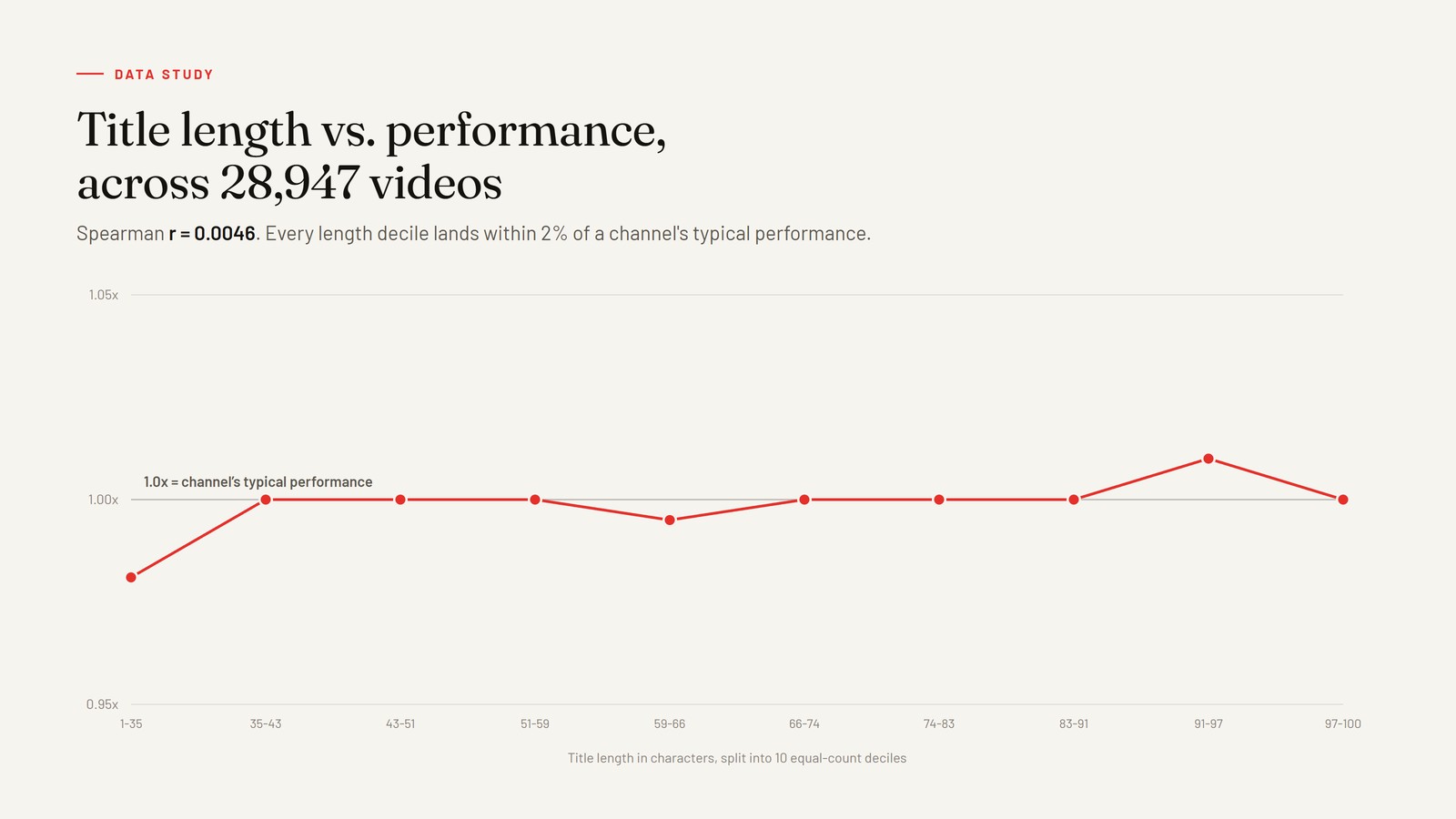
We wanted to know whether YouTube title length affects performance at all. Four published studies say it does, and each gives a different answer. ViewsKit says titles under 30 characters earn roughly twice the views of titles between 80 and 100. Briggsby puts the sweet spot at 20 to 40 characters. AIR Media-Tech says the answer depends on the niche. Subsub.io finds that top performers average 65 to 70 characters.
They cannot all be right.
So we tested it ourselves, part of our data studies: 28,947 videos across 707 channels, title length compared against a channel-and-age-normalized performance metric. We split the results into length groups, tested them across niches, and cross-tabbed title length against eight other title patterns.
The answer is remarkably clear: there is no relationship. We measured a correlation of r = 0.0046 between title length and performance, on a scale where 0 means no relationship and 1 means a perfect one. In other words, title length has essentially no predictive power.
It doesn’t matter whether a title is short, medium, or long. Title length does not predict performance, not weakly, not conditionally, and not in any niche large enough to test.
Key Findings
- No relationship, full stop. Across 28,947 videos, the shortest titles and the longest titles perform within 3 percentage points of each other. Statistically, that is zero (r = 0.0046).
- Holds in every niche. All 15 tracked niches came back negligible, tech and vlogs the closest to an effect and still too small to count. No niche where length matters.
- Holds combined with other patterns too. Titles with a number, titles without, question-framed or not, all four cross-tab curves stay flat.
- The closest real competing study agrees with us more than it disagrees. Subsub.io (120,703 videos) matches our numbers on questions. Its own "shorter wins" headline rests on a top-performer average nearly identical to our overall population median. That is what a null result looks like, not a real effect.
- One pattern shows a real, if small, effect. Titles with a year tag ("2026," etc.) perform 9.5% better than titles without one. Every other pattern tested, numbers, brackets, colons, all-caps, emoji, makes no measurable difference.
- One of the four widely-cited length studies doesn't check out. The "3M-video, 90-100 characters" claim traces to a website that does not exist.
Four Studies, Four Different Numbers
Every study below is real, sourced, and reachable. We opened and read each one this month. None agree on a number. One of the most-cited claims traces to a website that does not load.
| Source | Sample | Claim |
|---|---|---|
| Subsub.io (Feb 2026) | 120,703 videos | Top performers average 65-70 chars; "shorter wins, almost always" |
| ViewsKit | 61,838 videos | Under 30 chars ~2x the views of 80-100 |
| Briggsby | 100,000 videos, 75,000 channels | 20-40 chars is the sweet spot |
| AIR Media-Tech | 11 niches | No single number, depends on the niche |
| "3M-video study" (cited by 10xcreator.dev, echoed by ytzolo.com) | Claimed, unverified | 90-100 chars outperforms by 2x+ |
| Our data | 28,947 videos, 707 channels | No length effect, tested directly |
10xcreator.dev ranks first for "best youtube title length," citing a 3-million-video study and a 90 to 100 character recommendation. We tried to check that study more than once. The website does not exist. It never loads.
The same unlinked "3 million video" figure appears on two different ytzolo.com pages with two different numbers: a 10-14% lift on one page, "more than 2x" on the other. Nobody citing this claim read the same study. There is no study to read.
Five more sources give a length recommendation with no data behind it:
- TopicTree: 40-60 characters. No sample size, no methodology, no source.
- WildAndFreeTools: 45-60 characters, from unspecified "video audits."
- InfluencerMarketingHub: 70 characters flat, no source given.
- Uppbeat: 50-60 characters, no source given.
- Humbleandbrag: the one exception. It cites Subsub.io’s study directly instead of asserting the number as its own.
Key takeaway: four real studies give four different numbers, a fifth widely-cited claim traces to a website that does not exist, and several more zero-data guides fill the rest of the search results with unsourced ranges.
How We Measured It
Every tracked long-form video published since January 2025 with at least one recorded view snapshot. 28,947 videos. 707 channels.
For each video, we calculated velocity: views divided by days live. We then divided that by the video’s own channel median velocity. A video at 1.0x performs exactly as its channel typically does. A video at 2.0x performs twice as well as that channel’s norm.
Raw view counts mostly measure channel size, not title length. A length bucket with a couple of large channels in it looks like a length effect if you don’t normalize. Every video needs to be compared only against its own channel’s baseline. Our video length study used the same logic to find a mean-versus-median gap inside raw duration averages.
Limitation: this measures performance, not click-through rate. CTR requires impression data only a channel owner can see. We don’t have that for these 707 channels, and neither does anyone else’s study of other people’s videos. What we can measure is whether a video does better or worse than its channel usually does, a real outcome, just not identical to CTR.
Title Length Shows No Correlation With Performance
We sorted all 28,947 titles by length, shortest to longest, and split them into 10 equal-size groups. Here is how each group performed against its own channel’s normal:
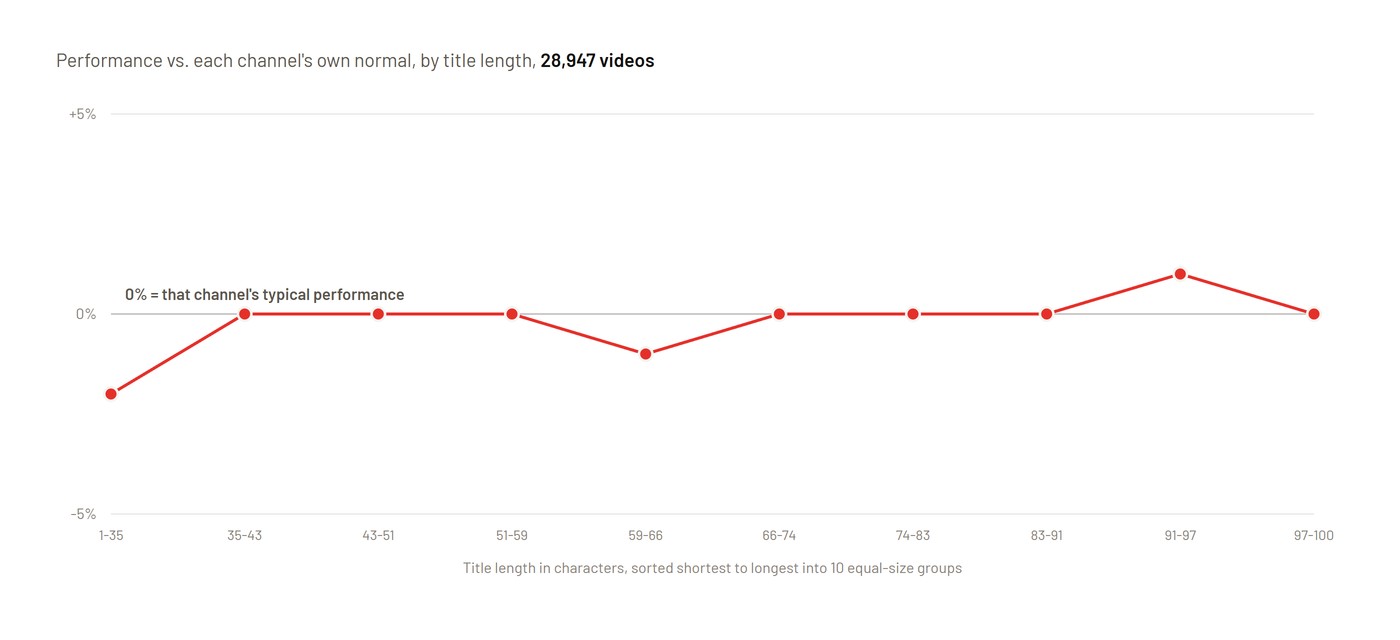
The line barely moves. The same numbers, in full:
| Title length | Performance vs. that channel’s normal |
|---|---|
| 1-35 characters | -2% |
| 35-43 characters | same |
| 43-51 characters | same |
| 51-59 characters | same |
| 59-66 characters | -1% |
| 66-74 characters | same |
| 74-83 characters | same |
| 83-91 characters | same |
| 91-97 characters | +1% |
| 97-100 characters | same |
The worst-performing group, 1 to 35 characters, is 2% below normal. The best, 91 to 97 characters, is 1% above. Everything else is a rounding error. That is the entire spread, shortest title in the dataset to longest.
Key takeaway: the shortest titles and the longest titles perform almost identically. The gap between the worst-performing length group and the best is 3 percentage points, out of 28,947 videos.
The Non-Effect Holds in Every Niche We Tested
AIR Media-Tech says it depends on the niche. We checked every niche with enough tracked volume to test properly:
- Skewed slightly toward shorter titles: tech, education, entertainment, sports, travel, gaming, news
- Skewed slightly toward longer titles: vlogs, music, comedy, fitness, cooking, finance, beauty
"Skewed slightly" is generous. None of these 14 niches showed an effect strong enough to call real. Tech leaned shortest. Vlogs leaned longest. Neither lean was big enough to matter.
Key takeaway: no niche, out of 15 tested, shows a real length effect. Not even the two closest to one.
Stop guessing at title length. Score the whole upload instead.SEO Studio checks your title, description, tags, and hashtags against what is ranking in your niche right now, not a length rule of thumb. Free to try.Try SEO Studio →Numbers and Questions Don’t Reveal a Hidden Length Effect
We tested whether length matters in combination with two other patterns: numbers and question framing.
We split titles with a number, and titles without, into the same 10 length groups, separately for each. Both come back the same: no group performs meaningfully better or worse than any other.
Question-framed titles versus statements: same result. Only 1,606 titles in the dataset are question-framed, so that curve is noisier. Still no consistent length pattern inside it. Length does not start mattering once a number or a question enters the title. It stays flat.
Key takeaway: the non-effect survives the two most obvious "maybe it's conditional" objections.
The Closest Real Study Agrees With Us More Than It Disagrees
Subsub.io has real methodology, a real sample, and measures several of the same patterns. Compared against our numbers:
- Length. Subsub.io: "shorter wins," top performers average 65-70 characters. Us: no relationship at all.
- Questions. Subsub.io: 6-8% of top titles, largely ineffective. Us: agree, no real effect.
- Numbers. Subsub.io: "still powerful," 32-40% of top performers. Us: barely moves the needle.
- Brackets. Subsub.io: slightly outperform average. Us: no measurable effect.
- Emoji. Subsub.io: large effect, but specific to Shorts. Us: no effect on long-form, Shorts excluded entirely.
- Capital letters. Subsub.io: strategic emphasis beats all-caps screaming. Us: no effect, on a cruder measure, present or absent.
Subsub.io’s own reported "top performer" average is 65 to 70 characters. Our overall population median, every video we tracked, not just the top slice, is 66 characters. Nearly identical. If shorter titles genuinely outperformed longer ones, the top performers’ average length would sit meaningfully below the population average. It doesn’t. Not in their dataset, not in ours. That is what a null result looks like even when a study headlines "shorter wins."
Key takeaway: even Subsub.io’s own numbers are consistent with no length effect, despite its "shorter wins" headline.
A Year Tag Is the Only Pattern With a Real Signal
Eight more structural patterns. Each checked the same way: prevalence, a median performance split, its own correlation.
| Pattern | Prevalence | Median lift | Correlation |
|---|---|---|---|
| Year tag (2026, etc) | 8.9% | +9.5% | 0.024 |
| Contains a number | 40.1% | +1.3% | 0.021 |
| Starts with a number | 6.0% | +5.1% | 0.017 |
| Has an emoji | 24.0% | 0% | 0.013 |
| Has a colon | 8.0% | -1.1% | -0.012 |
| Question-framed | 5.5% | -0.4% | -0.009 |
| Has brackets/parens | 7.2% | 0% | 0.002 |
| Has an all-caps word | 37.5% | 0% | 0.001 |
Only one pattern clears even a modest bar. Titles with a year tag perform 9.5% better than titles without one, the largest gap of anything in this table by a wide margin. Everything else, numbers, brackets, colons, all-caps words, emoji, is indistinguishable from noise.
Key takeaway: a year tag is the only title pattern tested with a lift worth naming. Everything else is noise.
Frequently Asked Questions
What is the optimal length for a YouTube title?
There isn’t one. Across 28,947 videos in our tracked dataset, the shortest titles and the longest titles perform within a couple of percentage points of each other. Statistically, that is no relationship (r = 0.0046). Pick the length the idea needs. Not a target character count.
How long can a YouTube title be before it gets cut off?
YouTube allows 100 characters. Search results and suggested feeds truncate around 60 to 70 characters, depending on device. Past that, you risk losing the ending. That is a display constraint, not a performance one. Titles past 70 characters perform the same as titles under 35 in our data.
What should I avoid in YouTube titles?
Avoid over-optimizing for length. It is not the lever it is treated as. A colon in the title and question-framed titles both trended slightly worse in our data, but too weakly to call either one a rule. Neither helped either.
How do I know if my YouTube title is good?
Not by its length. Title length, word count, brackets, capital letters, emoji: all negligible in our data. A good title is judged by whether it sets up what the video delivers. No character count measures that.
How many words should my YouTube title be?
The median title in our dataset runs 11 words, and word count moves performance about as little as character count does, next to nothing. A commonly cited figure elsewhere is eight words, from a 2026 Subsub.io study of 120,703 videos. Our own measurement doesn’t find word count moving performance either.
What is the YouTube 7 second rule?
A retention idea, not a title-length one. A video needs to hook the viewer within its first seven seconds or lose them to the next recommendation. Real problem, separate from what a title does. A title’s job is to earn the click. The first seven seconds decide whether that click was worth it. No title length fixes a weak opening.
Does putting a number or a year in my title help?
Marginally, mostly for year tags. A number in the title moves performance about 1.3%, close to nothing. A year tag like 2026 is the strongest single signal in the study: titles with one perform 9.5% better than titles without. Still a small effect, but the only one worth a second look.
What should I optimize instead of title length?
Whatever explains the huge variance we found. Individual videos ranged from roughly half a channel’s typical performance to more than double it. Title length accounts for almost none of that spread. That points to topic selection, thumbnail, and the video’s first seconds. Not the character count.
Stop Optimizing Title Length
Twenty-eight thousand videos. Title length explains close to none of what separates a video that outperforms its channel’s own norm from one that doesn’t. Individual videos range from roughly half a channel’s typical performance to more than double it, and almost none of that difference comes from title length.
What to do with that:
- Use a character counter to avoid mobile truncation, not to hit a target number.
- Write the title the idea needs. 24 characters, publish at 24. 95 characters, publish at 95.
- Use a year tag when it fits naturally. It is the only pattern in this study with a lift worth naming.
- Put the time you were going to spend counting characters into the thumbnail and the first seconds instead. That is where the real difference in performance comes from.
Four studies argued about which length wins. They were arguing about noise. Our own title formula guide is being corrected to point here instead of the unsourced "eight words" figure it previously carried.